What Are Values and How Do They Impact Your Life?
For some people, the word values has a clear meaning. For others, it’s a term they’ve heard in passing—or are only now beginning to realize it’s not just a vague concept, but a powerful guide for understanding oneself and shaping one’s life direction.
For many, values are presented through religion or culture. Others learn them through trial and error.
So… what are values?
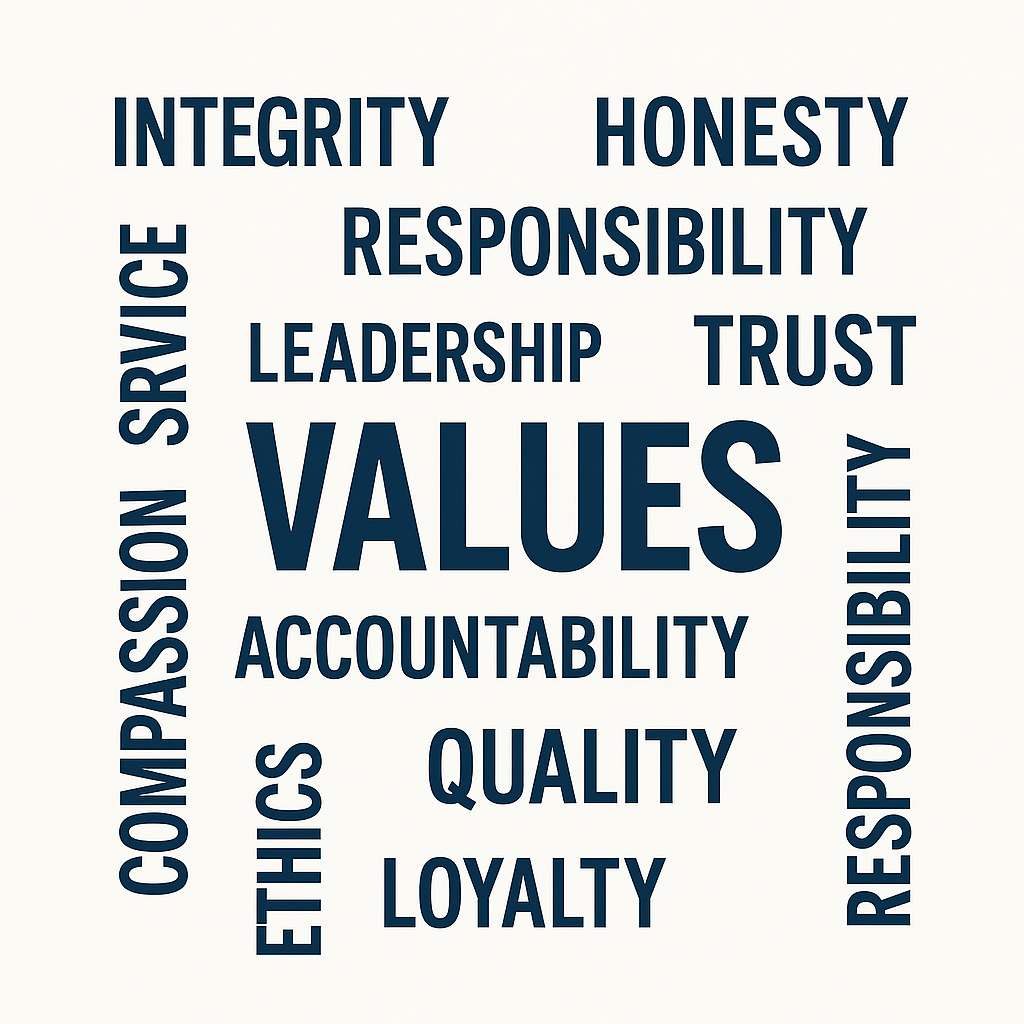
To oversimplify, values are simply words that we give deep personal meaning to. Words like integrity, family, authenticity, honesty, creativity. But not just any meaning—we make these words mean something about ourselves. When we’re clear on our values, we use them to make decisions, to help regulate ourselves when emotions start to take over. Our values shape how we talk and behave, how we want others and the world to see us—and ultimately, how we envision our lives unfolding.
In fact, these are often the words we’d hope people would use to describe us at our funeral:
“They were so authentic.”
“He was so creative.”
“She lived with so much integrity.”
Values guide our path through life.

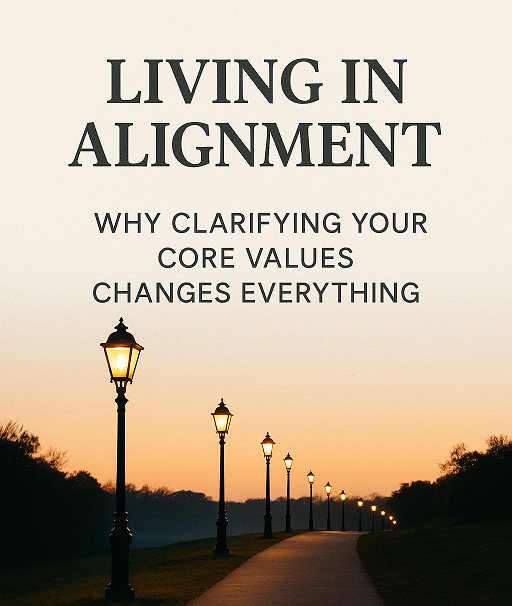
The Path Metaphor
You may remember the path analogy I used when we talked about misalignment burnout, but I’ll revisit it here.
Imagine we’re each born into or set on a path. This path has hills and valleys, bumps and potholes. It will intersect, run parallel to, and sometimes even merge with the paths of others.
When we’re clear on our values, we can recognize our path more easily. We’re able to navigate the bumps, detours, and obstacles—not because the road is perfect, but because we know where it’s leading and what it’s teaching us. We understand why it matters.
But when we’re unclear on our values, it’s easy to veer off course. We might follow someone else’s path—because it looks nice, because we were told to, or because we think it’s the “right” one. Or maybe we start bushwhacking through a totally new direction, unsure of where we’re headed.
Whatever the reason, at some point we get tired. Worn out. Lost.
Burnt out.
Burnout, in this sense, becomes a signal—a symptom of being out of alignment with our values.
Your values, like old friends or distant beacons, start calling to you:
“Hey! You’re going the wrong way!”
And you yell back: “I know what I’m doing, leave me alone!”
And you keep going, tripping, stumbling, fighting the terrain. Wondering why the path seems easier for everyone else.
Eventually, you fall—exhausted.
Not because you’re weak. But because you’ve been trying to live a life that isn’t yours.
And that exhaustion? It’s information.
It’s a moment of reassessment. A cue to re-evaluate where you are, and where you actually want to go. And even if you’ve wandered far—especially if you’ve never been clear on what your values are—you can always return to them. You can always rediscover them.
They’ll be there, waiting for you.
A Personal Story: Relationship Values
Let me tell you a story about the first time I realized how values impacted my life—specifically, in relationships.
I had found myself in one relationship after another that just wasn’t working. And I couldn’t figure out why—until the last one, the one that finally cracked something open.
She was a wonderful human. The difference between us? She was clear on her non-negotiables—what she actually called them. Looking back, I now see that her non-negotiables were really just her values.
One of her values was independence. She didn’t need to be with her partner all the time. In fact, she’d joke:
“Hey, you’re not one of those guys who needs to be with their partner 24/7, are ya?”
And I’d laugh it off—“Of course not, pshht.”
(Clears throat awkwardly.)
Turns out…I am that guy. I value closeness, consistency, daily connection. I didn’t like when she traveled without me. I wanted to see her every day if possible. For her, it was no big deal to go a few days without seeing each other. In fact, she’d sometimes decide which days we’d see each other.
I tried to go along with it. But I was uncomfortable—really uncomfortable. And I didn’t know why at the time, but it felt like I had given something up. Like I’d cut off a limb and was quietly expecting her to pay me back for it.
This is what can happen when we’re out of alignment with our values—or when we trade them in for someone else’s. We unconsciously expect something in return.
For me, it led to resentment. The fights became frequent. Always about the same things, looping and unresolved, because the core issue—our values—wasn’t being named.
Eventually, she took a solo trip to Spain. Photos popped up on Facebook of her and a guy named Pablo. I don’t actually think anything happened between them, but I hated it. I mean, really hated it. I remember thinking, “I would never do that to her.”
So why was she doing it to me?
I took it to mean she didn’t care. I ended the relationship—maybe even while she was still on the trip. But when I did, her response made it clear that she did care. She did love me.
It just turned out that our values were different.
She wasn’t wrong. I wasn’t wrong.
We were just… wrong for each other.
That experience taught me a powerful lesson about knowing—and owning—my values. I spent time afterwards getting clear on what my values were in a relationship. And not long after that, I met my wife.
As I write this, we’ve been married 10 years and together nearly 12.
Values Show Up Everywhere
Values don’t just show up in relationships—although they certainly matter there. They show up in your work, your family life, your friendships, your hobbies, your sense of purpose, your health—mental, physical, emotional, spiritual.
When you’re aligned with your values, you’re aligned with your whole self.
Leave a Reply