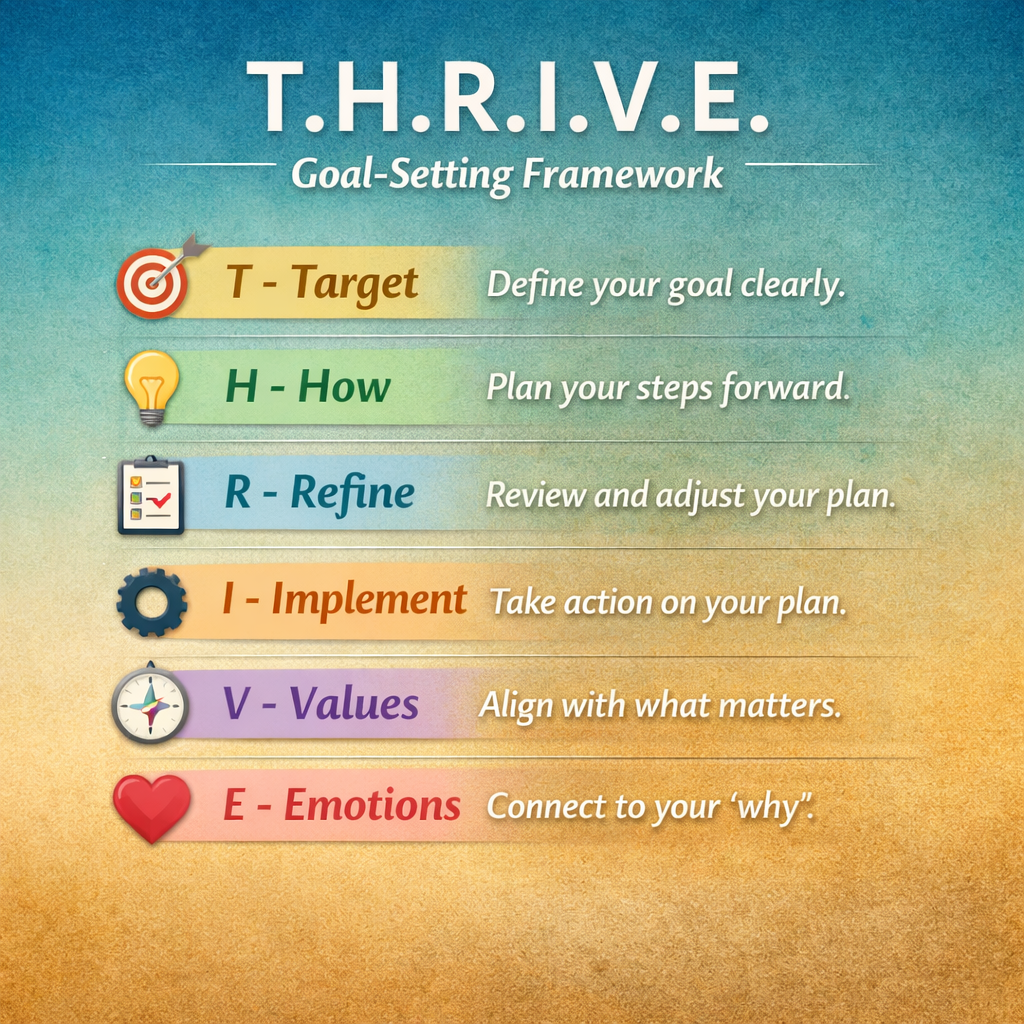
Thrive Goal-Setting
This week’s reflection is centred around goal-setting. I know for some that can be an exciting topic, and for others, well, let’s just say it can bring up some stuff. With that said, we are one month into the new year, and it’s typical to set goals and intentions—resolutions, as it were. I spoke about this in the last article, specifically regarding the importance of preparation: the how.
Over the years, I have spent a lot of time working with students, clients, and myself around this topic. Goal-setting is often something many people know about but are also very resistant to. This resistance is often the result of goal-setting being commonly used in corporate and scholastic settings, which have left a bad taste in the mouths of many.
In a corporate setting, it’s often jargon. The use of “SMART” goals is all too familiar. Leadership gets you pumped up to use this strategy, only to whack you with it—like a stick—when you fall short.
In school, goal-setting was brought up, and I don’t know about you, but I truly had no clue what made the concept important. It was just another school project that I did poorly in. Yes, some part of that was my struggles in school as a whole, and I also believe that the value of setting intentions and goals was poorly delivered.
I have found that I am not alone in this. When the time comes to teach the goal-setting component to my coaching students, there is quite often a collective shudder at the thought. This typically leads to a very rich discussion and discovery that many feel the same, but that there is a common thread.
Goal-setting, for many, has been a difficult experience, leading to limiting beliefs. What I commonly hear is: There’s too much pressure. Or, It’s wrong to put deadlines. Also, Setting a goal is just another thing for me to fail at. And, They never seem to work. Whatever the thinking may be, the theme is a limiting belief that keeps most from seeing the wonderful potential that a well-thought-out goal can achieve.
Most people have heard of the “SMART” goal technique—an acronym designed to bring structure to goal-setting: Specific, Measurable, Achievable, Relevant, and Time-Based. When it was introduced in 1981 by George T. Doran for corporate management, it was no doubt a game-changer.
The challenge is that when this model is applied to everyday life, something essential is often missing. Structure alone doesn’t account for values, emotional motivation, or the internal resistance many people experience. Without those elements, even well-defined goals can quietly fall apart—especially outside of corporate environments.
I would like to offer a goal-setting tool—or model, if you will—that may help address what seems to be missing, based on my work with students and clients in the coaching world.
Similarly, I’ve used an acronym that I hope will be easy to remember and that captures the ultimate goal: T.H.R.I.V.E. Because that is what I genuinely hope for everyone—to thrive in whatever way makes sense to you. And because I believe goal-setting can be a powerful contributing factor, I decided to combine the two.
T – Target
Having a clear target in focus is the first step. Know where you want to go, what the desired outcome is, and the details of your target goal. Be sure that the goal is yours. Far too often, people set goals that were never theirs to begin with—based on external influence or internal pressure.
This goal is yours. Own it, and keep a clear target in sight. The simple act of setting a target reinforces motivation. A target gives direction, and direction inspires a sense of purpose.
H – How
My previous article focused entirely on this part of goal-setting. Suffice it to say, I think it’s important—possibly the most important… well, nearly.
The how refers to how you will actually do the thing. It’s not enough to state what you will do; you must be clear on how you will do it. This is one of the most commonly overlooked aspects of goal-setting. Once a target is established, it’s easy to want to jump straight in without a clear plan. This often leads to giving up when the first obstacle appears.
Having a target is the first step; the next is considering how you will close the gap between where you are now and where you want to be. This includes considering not only what could go right, but also what could—and likely will—go wrong.
Preparation includes practical considerations such as time, finances, tools, and resources, as well as personal factors like limiting beliefs, unhelpful habits, and thinking patterns. In other words, it’s about accounting for all the ways you will need to approach this goal, including all the ways you might mess it up.
This stage is a divergent space for thinking—considering all options, no matter how unrealistic. This helps bring forward new perspectives and ideas.
R – Refine
The previous step is where divergent brainstorming takes place; this step is where convergent selection happens. Allow space for all possibilities to surface, then begin refining the list.
Weigh the pros and cons. Consider what works best with your current skills, what support you may need, and what resources you have available.
Add a timeline at this stage—not as a punitive deadline, but as another guiding target. Timelines help maintain momentum and motivation. For many, time limits add stress because they are associated with consequences. This is not that. This is for your use only and can be adjusted as needed. Move it closer if you can achieve it sooner, or extend it if you need more time—just be honest with yourself.
Refine until you have something you can realistically manage and that begins to excite you.
I – Implement
This is the do-the-darn-thing stage. Take the first step, knowing that things may not go according to plan—and that’s okay. Observe what works and what doesn’t. New information will emerge either way.
If it doesn’t work, revisit the plan with that new information. If it does, celebrate the win and move forward.
V – Values
You may recall my reflection on values from a while back. I describe values as a guiding beacon—markers that remind you where your path is. Life becomes clearer when we are aligned with our values. Decision-making simplifies, and when we veer off course, our values help light the way.
This is no different with goals. Being aware of your values means checking in with them throughout every step of the process. When your goals align with your values, they help you stay committed regardless of the challenge.
E – Emotional Motivation
Take a moment with this goal. Pause and reflect. What does it feel like to accomplish it? Name the emotion.
If this goal truly matters to you, emotion will be present. Ask yourself: What does this give me? How does this improve my life? More energy? More time with loved ones? Greater peace? Coversley, ask yourself, what happens if I stay the same, if I don’t accomplish this goal?
Alignment with values and emotional motivation are the most powerful drivers for staying on track.
For my wife, it was her art.
She is a beautiful artist. When we had our children together, she lost touch with her art. She, like so many parents, began to believe that, as a parent, she no longer had access to such things. We sat and had a discussion about this.
The discussion came because she had grown rather down, not necessarily unhappy, but heavy, ya know? Fighting every urge, in my husband mind, to offer solutions and fixes for the issue, I listened and asked what art did for her. She said it was like her therapy. As a therapist, I understood immediately that this was more than art; it is her self-care, her choosing of self. I asked what happens if nothing changes? “ I stay bloppy,” she said, that’s her word for feeling down and frumpy.
She looked at her two options: self-care, therapy and happiness as opposed to, well, staying bloppy. Once she gained clarity for herself, what she stood to gain and what would happen if she stayed the same at an emotional level. She found the motivation to do whatever it took to carve out some space.
It started as a small table that could be pulled and put away as needed, and it started as 20 minutes here and there. As time went on, it became a full section of our home and time whenever she chose, often for hours at a time. What began as a small table and short sessions grew into a dedicated space, creative freedom, a children’s book, sold artwork and dedicated self-care and choosing of self.
All this to say: know your why. Know your emotional motivation, and it becomes very hard to stand in your own way.
“V” and “E” appear at the end of this model, but they should be present from the very beginning. Every step can—and should—be revisited. Even with preparation and alignment, plans fall through, resources change, life happens, and mistakes occur.
Learn from them. Adjust. Realign. Try again.
The journey is long and often messy. Remember—you don’t have to do it alone.
Until next time, dare to mess it up. Dare to fail forward.
Ciao
Leave a Reply