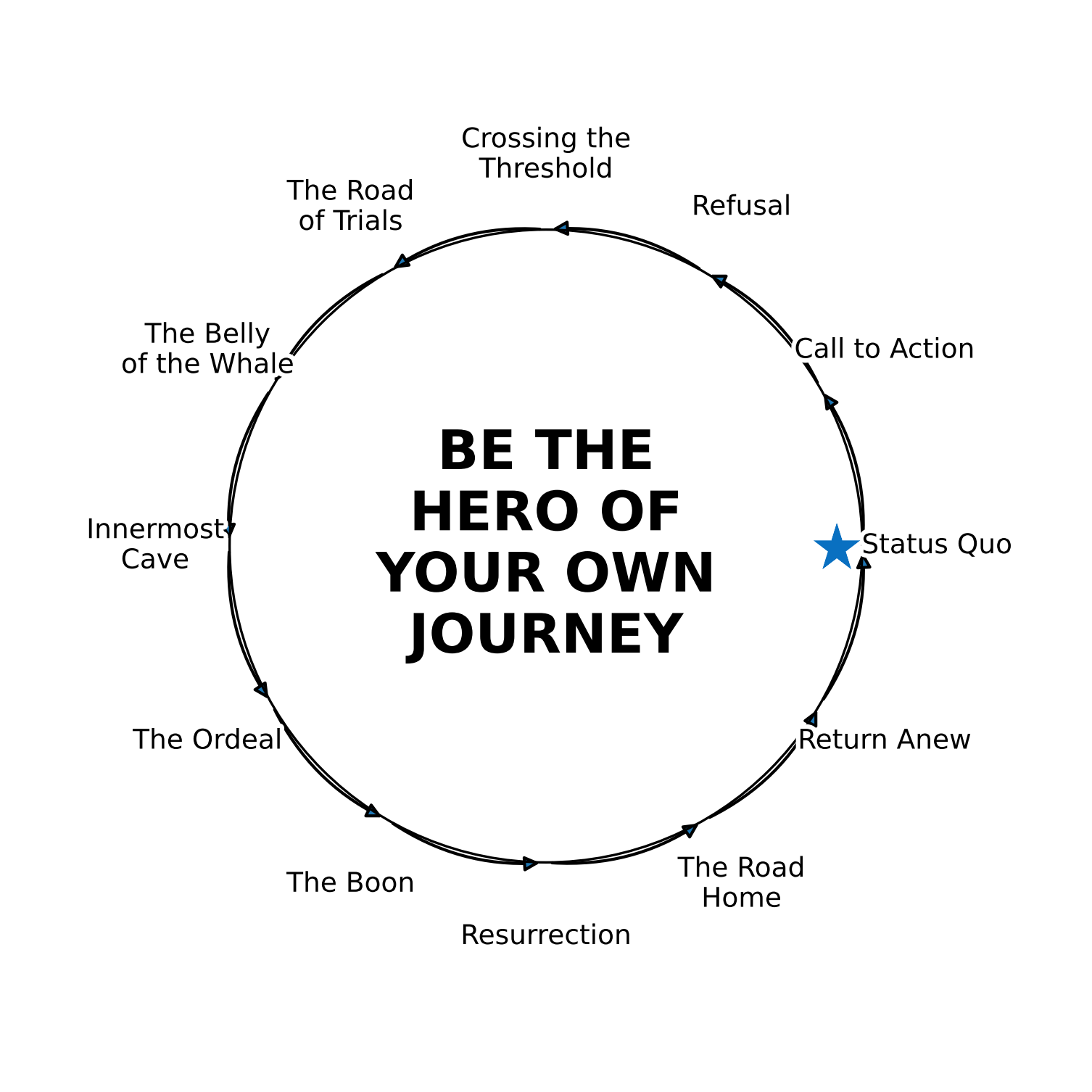
The hero’s journey. Joseph Campbell, a writer and literature professor, dedicated a great deal of his life’s work to studying the stories, religions, and mythologies of the world, discovering what he described as a common pattern between them all. He called this the monomyth—or, as we more commonly know it, the hero’s journey.
Don’t worry if neither term is familiar to you. If you’ve ever watched Star Wars, The Lord of the Rings, The Matrix—or really most of the popular movies and stories of our time—you’ve likely witnessed some expression of this monomyth, this hero’s journey.
You may be curious how this connects to this week’s article. Campbell’s powerful discovery didn’t just influence George Lucas; it has also been a significant area of focus in philosophy and psychology. What makes the hero’s journey a fantastic storytelling model is that it closely reflects what most of us—if not all of us—experience or, more accurately, need to experience to live a fulfilling life.
In this article, I want to draw parallels between our everyday modern lives and the hero’s journey. I want to show how all of us, to some degree, are reluctant heroes called into action, each facing our own dragons and empires to overcome.
First, a Reflection Activity
Try not to qualify or judge your responses. This is just for you.
Recall a moment when you were called to action. This could be a significant change thrust upon you or a change you needed to make for your own well-being. Perhaps an opportunity came up that you had the chance to take.
Now consider what challenges arose and how you navigated them.
Did you face them head-on, or did you turn away?
What was the result?
If, as you reflect, you notice that you tend to turn back more often than you face your challenges, know that this is normal. It’s common for people to turn back. Remember the fear of failure choice loop from last week’s reflection? One of the causes of turning back is that so many of us do not see ourselves as the heroes of our own story. Limiting beliefs—internal and external naysayers—convince us that we’re the side character. And when we believe that, it becomes easy to stay stuck, to loop back into the discomfort of old ways rather than stepping forward, embracing the adventure, overcoming trials, and ultimately slaying the dragon.
The Hero’s Journey: A Quick Overview
Campbell’s hero’s journey is considered a loop. It typically starts with the status quo and call to action, leading into adventure, trials and tribulations, the great foe, and eventually a return home—newly changed.
The first stage, the ordinary world or status quo, is where life is as we know it: routine, familiar, perhaps comfortable—or for others, boring. Bilbo, for example, was content with his adventure-free life, while Luke was bored on the farm with his aunt and uncle.
Either way, the hero stands on the precipice of change—wanted or not.
And then the call to action arrives.
This is the moment the hero is invited or thrust into adventure. Bilbo receives a visit from Gandalf. Luke discovers a message from Princess Leia. Neo receives a mysterious message on his computer. Calls vary—sometimes a whisper, sometimes a shout.
And what often comes next?
Refusal of the call.
The would-be hero becomes convinced they aren’t strong enough or aren’t “the one.” That whisper becomes a shout. The invitation becomes a demand. Luke refuses Obi-Wan until he discovers the farm destroyed. Bilbo insists he’s no burglar. Neo exits the car, staring down a dark alley—but realizes he can’t return to the status quo.
“You know where that road leads, Neo.”
Next comes the supernatural aid—the teacher or guide who helps the hero see their potential. Obi-Wan, Gandalf, Morpheus.
The hero then crosses the threshold into the unknown. Sam and Frodo leave the Shire; Luke enters the vast universe; Neo chooses the red pill. Once the choice is made, the hero enters the belly of the whale—the moment of no return.
Then comes the road of trials. The hero faces tests, discovers allies and enemies, trains, makes mistakes, fails, learns, and gradually becomes strong enough to face the great challenge.
Approaching the innermost cave means confronting the primary foe: Smaug’s lair, Mordor, the Death Star. The battle ensues; the hero “dies” and returns changed, claiming the boon.
Finally, the hero returns home—the resurrection and reintegration—now transformed, seeing the world with new understanding.
So… You’re saying I’m Neo?
You might be thinking, “Awesome, great! When do I become a Jedi?”
“Well, I don’t know any wizards, but I’ll trust the process,” haha.
There may not be a literal wizard or Jedi and you are not exactly Neo, but in a very real sense, you are The One.
It just looks different in your story.
Let me expand.
I’ll walk through the hero’s journey again—this time drawing comparisons to the stories most familiar to us regular folks. These are the stories I’ve encountered in my own life and in the lives of my coaching and counselling clients.
Although we don’t know actual wizards and the world isn’t being threatened by an evil sorcerer, we each have our own foes.
Let’s begin with the call to action.
It may not be a grey-bearded wizard or a robot delivering a princess’s message, but it may be something very real: a friend pointing out a harmful behaviour, your body warning you to change, a job loss, a diagnosis, or a life event that leaves no room for delay. It could also be something you can choose—an opportunity, a healthier direction, a new start.
This is the call. Sometimes a hint; sometimes a sledgehammer.
The question is: How will you answer it?
Most of the time, we answer with denial. Refusal sounds like:
“I know I need to change, but…”
“I’m not good enough.”
“Life is stacked against me.”
“It’s not the right time.”
This refusal might happen more than once—again, the choice loop—but eventually the call comes in a way that cannot be ignored. When the pain of staying the same outweighs the fear of change, we accept the call.
Finding Your Supernatural Aid
In real life, your Obi-Wan or Gandalf may be a mentor, coach, or counsellor.
It’s usually at this stage—of readiness for change—that clients find me.
This is not someone who tells you what to do, but someone who helps you uncover your own potential.
This stage is where you begin to see that you can do this—
and that you don’t have to do it alone.
Here you begin mapping out what comes next, preparing for the version of yourself you’re becoming.
Then you cross the threshold.
Crossing the threshold is choosing discomfort for the sake of growth:
turning a hobby into a side hustle, advocating for yourself, ending unhealthy relationships, leaving a job, starting fresh. Whatever it is, you’ve chosen to do the darn thing.
People say the first step is the hardest—and it often is. But staying the course is its own challenge.
In Campbell’s monomyth, the next stages are the belly of the whale and the road of trials.
Here, you discover who supports you and who doesn’t.
You face practical obstacles—time, money—and internal ones—beliefs, fears, ego.
Most people eventually discover that the greatest foe was never the external challenge.
The real dragon is often ourselves.
The innermost cave becomes an inward journey. You confront ego, limiting beliefs, old patterns of protection that once served you but now keep you stuck. Facing this part of yourself is profoundly difficult. It requires radical accountability—not shame, not self-condemnation. Simply truth.
The ordeal is the battle with yourself.
The boon is reclaiming yourself.
You emerge changed, aware of who you want to become. And yes, this means letting an old version of you “die.” Grieving that version is common and normal.
The hero falls and then is resurrected.
The road home is integrating your new story—inviting in people aligned with this version of you and releasing those who no longer fit. You know who you are. You know what matters. And you are no longer swayed by what once dissuaded you.
The journey comes full circle. You are changed and ready for the next call.
And often at this stage, people want to help others on their journeys.
The hero becomes the aid.
My Own Hero’s Journey
I know this because I lived it.
My journey required overcoming burnout, changing careers, healing from my misuse of alcohol, and facing the unresolved grief—death and non-death losses—that shaped my life. My physical, mental, emotional, and spiritual health were compromised. I denied the call again and again—until I no longer could.
The journey has been epic.
The battles fierce, tiring, and deeply saddening at times.
But here I stand. I understand myself in ways I never could before.
When the call comes, I am ready to answer—well, most of the time.
The journey continues as long as I’m actively participating in this thing called life. I accept that the calls will keep coming, and I will take up my mantle. And when I complete the circle, I will remember to cherish and celebrate the adventures that have shaped me.
It is why I am a coach and counsellor.
It is why I am an educator for those who wish to become coaches and counsellors. It is an honour to partner with the heroes embarking on their own journeys—to witness, in some small way, others facing their dragons and becoming ready to help others in turn.
My Hope for You
My hope is that, reading this, you will answer the call in the way that makes sense to you.
That you will find your aid—whoever that may be.
That you will face the trials, even when you make mistakes, even when you get knocked down, even when you fail.
You will get up.
You will dust yourself off.
And you will complete your grand adventure.
You’ll dare to mess it up.
You’ll dare to fail forward.
And you’ll remember—you do not have to do it alone.
Until next time,
Ciao!!
Leave a Reply