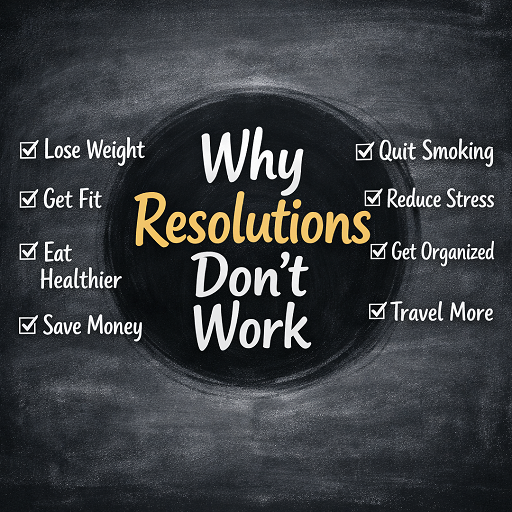
I’m just going to say it: New Year’s resolutions don’t work—haha. There, I said it.
Okay, okay… they don’t typically work, but they can.
The new year is here. It’s common, if not tradition, to consider all the ways we will have a better year. This year will be my year! we proclaim. New year, new me! New Year’s resolutions are very common, and it’s fair to say why. Of course you want to change—in fact, you should. If we are actively participating in this thing called life, then finding ways to improve, to become the next evolution of ourselves, makes sense. Resolutions, intentions, motivation to change, kicking unhelpful habits and behaviours—all of it makes sense.
The end of the year often brings a need for rest and nourishment. The beginning of the new year often prompts a need for change. This is normal throughout the ages. From culture to culture, the new year means a new you in some form or another. Motivation is high, the drive is palpable. You are truly inspired to do the darn thing!
And if you are anything like me, you also know that a few months—maybe even a few weeks—down the road, the old you returns. Ideas of the new you fade. Perhaps shame takes over, and back into that loop you go.
Perhaps this year the change can be different. Perhaps how you change is what needs to change.
Stick with me here—but what if the issue is that you don’t really know how to change? I mean, sure, you get the obvious stuff. You know what the outcome looks like. But do you know what it takes to get there? Or how to get there?
It’s normal—even common—to claim what you want to accomplish and then set off trying to accomplish it, only to find it’s not sustainable for whatever reason. At that point, it becomes all too easy to revert back, or to find yourself already doing the things that really don’t serve you anymore.
In this reflection, I want to share what is often the most common cause of failed resolutions and goals—something I’ve discovered is true not only for clients, but for myself as well. What I share here can help you not just set an intention, goal, or resolution, but also stick with it and achieve the outcome you most desire.
I won’t mislead you by calling this foolproof or guaranteed. This isn’t “three easy steps to realizing your resolution.” But I will say that this has worked—and does work. And it really will depend on you.
Let’s Start With an Exercise
First, name what it is you want to work on this year. What is the New Year’s resolution you’ve chosen? Is it quitting smoking? Getting to the gym more? Getting out into the world more, making new friends, or working your bliss more?
Take a moment to write down what your thing is.
Now, you might be thinking of this for the first time right now. For others, this is the part you’ve already thought about but find yourself unable to see through. What comes next is what is often overlooked when setting intentions, goals, or resolutions.
I’m using different terms for the same thing because many of us have different relationships with different words. For example, if I say goal setting, how many of you get a little squirmy? Maybe even resistant—because that term gets used in school or corporate settings and often comes with punitive consequences for not reaching said goals.
For others, the term resolution is sticky because of how often it’s used this time of year. It can feel cliché, like the thing-you’re-supposed-to-do. Maybe it even feels disingenuous. Even intention setting is thrown around a lot and can seem trendy, like a social media buzzword.
I’m naming this because—believe it or not—your relationship with words, and the conscious or unconscious beliefs you hold about being the kind of person who uses them, might be the first hurdle you need to overcome. At the first sign of an obstacle on your way toward your intention, goal, or outcome, you may fall back on things like, “Resolutions are stupid anyway,” or “I never agreed with goal-setting once it became corporate jargon.”
Can I be blunt here? You’ve got to get over that.
Sorry to say it like that—but they’re just words you’ve given meaning to, and that meaning is now feeding your limiting beliefs.
I genuinely want you to find success here—whatever that looks like for you. And a big part of that is naming and taking accountability for how you may have been getting in your own way. If you’re a little butthurt reading this, I get it. You can choose to stop reading now—or you can choose to acknowledge that I might have hit on something meaningful. It’s your choice, and that’s exactly what I meant when I said the outcome would depend on you.
With that said, let’s get back to what many people overlook when setting goals and resolutions.
With inspiration and motivation, we step out to accomplish the challenge that has so often eluded us in the past—bright-eyed and eager, with a this time it’ll work mindset. I know this all too well, and sometimes I even stick with it longer than usual.
It’s usually at the first sign of adversity that we’re dissuaded. Or when something challenging happens in life, we fall back and say, Now’s not the time. I would, but I’m exhausted. I would, but other things are more important right now. It’s the time, the money, the and, and, and…
All of which may be very real reasons—or excuses. And all of which are inevitable. In other words—and if I may be blunt again—these derailments are common occurrences when we are actively participating in this thing called life. Money, time, and misfortune are inevitable.
So what does that mean? It means it’s not enough to proclaim your intentions for all to hear. It’s not enough to feel inspired and motivated—although that is necessary. You must also prepare.
While you’re clear on what’s important to you, and while motivation is still sky-high, it’s crucial to establish the how alongside the what. The what is the desired outcome. The how is the plan.
The what is the easy part. Understanding how you’ll move toward accomplishing it is the challenging part.
It’s in mapping the how that we begin exploring all the ways we can accomplish this exciting new version of ourselves—and also, with rigour, all the ways we can and will mess it up.
Life will get in the way. You won’t have the time. You won’t have the money. This might be a hot take, but life isn’t about avoiding challenges or ignoring discomfort. It’s about acknowledging that challenges happen and recognizing that we can still advance in some form, even when we don’t know what’s coming. We can’t predict obstacles—but we can learn to pivot when they arise.
In the restaurant industry, there’s a term: mise en place, which essentially translates to “everything in its place.” If you’re new to the kitchen, it means ensuring everything you need for service is ready. The fridge is stocked with backups. The line is topped up. Tongs, towels, knives—all where they need to be.
Those who’ve spent time in the weeds know that mise en place is more than just physical preparation—it’s a philosophy. When service hits full throttle, you don’t know what’s going to be thrown at you, figuratively or literally. Hungry humans can be cranky. Some kind, some not so kind. In the back, a batch of bread gets burned, a cambro of sauce gets dumped, the prawns are off and now your most popular dish is 86’d. An unexpected tour bus breaks down nearby. The game is on. You’re already booked solid. Your backup prep person calls in sick. And your top cook took the day off because they just went ahead and had a baby—how dare they.
Mise en place means knowing it’s all going to happen—and preparing anyway. With a solid prep list, the right crew, and a good supply of Band-Aids and coffee, you can survive service, clean down, restock, and do it all again tomorrow.
In other words, we don’t run a restaurant just knowing we need to put food on the table. We prepare for what we hope will go well and for what we know—without knowing—will go wrong.
(Just pausing here to acknowledge any anxiety I may have stirred up for my restaurant friends.)
All of this is to say: preparation is a crucial component of any resolution, intention, or goal—whatever language you prefer. If you’re going to try something new, take the time to understand the how along with the what.
When we skip this and jump straight into doing, we often turn back at the first obstacle instead of recognizing that the roadblock is not only normal, but part of the process. When we embrace the philosophy of mise en place, we also embrace the idea that when things go sideways—when we’re in the juice—we’re actively reinforcing our strengths by pressing forward and finding ways to pivot.
Instead of bailing because we don’t know what to do next, we dig deep. One order at a time, we don’t just survive service—we conquer it. We reinforce the new version of ourselves not just by doing the new thing, but by doing it in the face of adversity, with adversity as our teacher.
Now, revisit the activity from earlier—the one where you named your New Year’s resolution—and start stocking your station. What do you need? Who’s on your crew? Name all the ways things might go wrong and start preparing for service.
This is where I remind you that working with a coach can be incredibly effective. Think of a coach as your executive sous chef—partnering with you through service. And if that’s not a fit, take the time to figure out who or what is.
Start there and notice the difference as you pursue your goals. Remember to consider your emotional motivation—your why—and how this all fits into the life you want to create.
What + How + Why = powerful results.
There you’ll see just how achievable your resolutions really are. I’ll write more about those pieces in reflections to come, but for now…
Remember: the journey is long and often messy. Mistakes happen. Things don’t always go to plan. So dare to mess it up. Dare to fail forward—because from our mistakes, we learn.
Until next time,
Ciao!
Leave a Reply