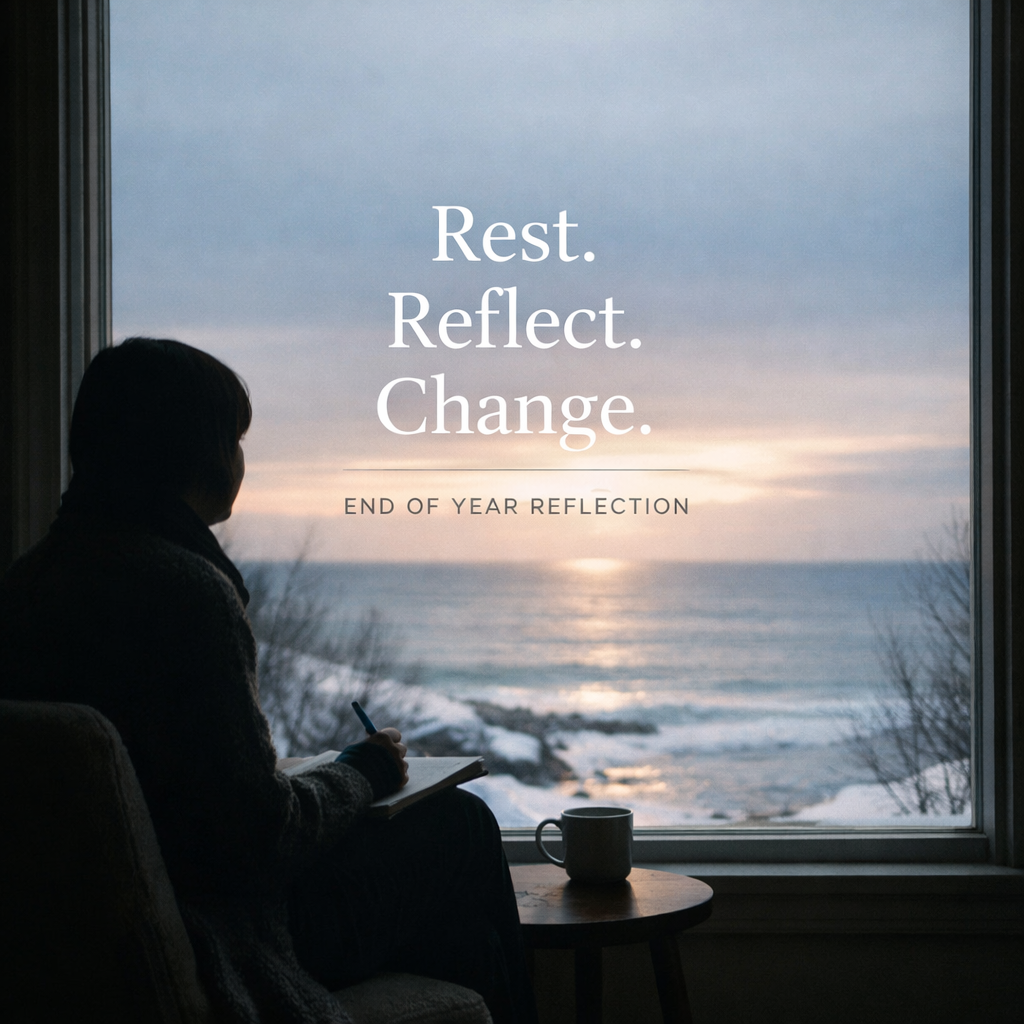
An End-of-Year Reflection
We are nearing the end of the year. The holiday season is upon us, and this can mean many different things to many different people. For some, it’s a time of joy and connection. For many others, it becomes a season of hustle and bustle—running around, shopping, visiting, and trying to keep up.
The idea, of course, is to enjoy the holidays with loved ones, to give and receive… right?
What so often shows up instead is stress. Stress from spending, stress from strained relationships, or the distress of perhaps not having anyone to be with. Some people will get time off but won’t truly feel rested. Others will remain busy working straight through the season. And most—consciously or unconsciously—will look back at the past year and begin to qualify the results, judging themselves and sometimes even slipping into self‑deprecation.
This is what this article is about: the end‑of‑year self‑assessment so many of us fall into. The year‑end evaluation that often leads to New Year’s resolutions that, as we know, more often than not fizzle out by February.
Feeling a little called out? Don’t worry—I know this pattern well because I’ve lived it, time and time again. And if you’re feeling judged, there is information worth paying attention to here. The real question isn’t simply what needs to change, but…
What is driving the need for change in the first place?
You know those people who genuinely enjoy the hustle and bustle of the holidays? The ones who have their decorations up in November, their lists completed early, and maybe even a freezer full of holiday baking. You assume they must not work full‑time, or maybe they don’t have kids. And then you find out they do—sometimes both—and you think, How? I can barely manage what I have, and I’m already dreading the season.
I know I wondered that myself. And if I’m honest, I could be a little… okay, a lot resentful.
Over the past few years, I’ve done a lot of inner work. Through that process, I’ve learned much more about what it means to live a life that feels meaningful—not just to me, but to my loved ones as well. I’ve learned to be more present, to welcome self‑care and rest when they’re needed, and just as importantly, to recognize when real change is required rather than avoiding both care and change altogether.
For a long time, I had all the reasons why change couldn’t happen now and why rest and care were things I hadn’t really earned.
The truth is, I was living the way so many of us do: putting myself at the bottom of the priority list, postponing the changes that could lead to a better life—not just for me, but for my family as well. Year after year, I would arrive at the end of the year feeling dissatisfied with what I’d accomplished, telling myself, Next year will be better, while changing very little. Sound familiar?
If you see yourself in this, try not to be too hard on yourself or dwell on the negatives. Instead, gently look at what actually needs to shift.
The more we learn when to rest, when to reflect, and when to make meaningful change, the more we’re able to embrace the present moment—and the life we’re living, hustle and bustle included.
Rest, Reflection, and Change
Let’s break this down into three parts: rest, reflection, and change.
- Rest
First things first—let’s determine whether what’s truly needed right now is rest or change.
For many people, reaching the end of the year marks a time of much‑needed respite. In many cultures, this season is seen as a natural slowing down—a time of death and rebirth, of honouring cycles, and of turning inward. It’s a time to decompress, to reconnect with yourself, your loved ones, and even the natural world. A time to reflect on the year that has passed, to recharge, recalibrate, and reset before the rebirth of spring.
Many of us simply need rest and self‑care. The deep desire for rest can sometimes fool us into thinking something much bigger—a major life change—is required. And for some people, that’s absolutely true. But before making any significant changes, the invitation is to first allow yourself to rest.
Give yourself care. Participate in the season. Recharge.
Often, once we truly nourish our need for rest, our love and passion for the life we’re leading begins to return. That’s usually a strong indicator that rest—not radical change—was what was needed. In that way, rest can act like a reset switch.
You might ask yourself:
Do I feel physically tired even when I’m doing things I normally enjoy?
Do even small tasks feel harder than they should?
Does rest feel appealing rather than boring or frustrating?
When I imagine taking a break, does my body relax?
Have I been “pushing through” for a long time?
If you’ve answered yes to several of these, rest is likely the primary need.
Even if change is ultimately required, rest often brings the clarity needed to determine what that change truly is. For this reason, it’s wise to avoid making major decisions during this time of year, when exhaustion and emotional overload are common. - Reflection
After rest comes reflection.
As important as rest is, so too is intentional reflection. Many people reflect, but often in a way that’s harsh, critical, or unhelpful. When you zoom out and look at the year that’s passed, don’t forget to reflect on what worked as well.
There is information in what didn’t go well—but there is also valuable insight in what did.
Compared to this time last year:
What has improved?
What has gone well?
Where have you grown, even quietly?
Life gives us both comfort and discomfort, ease and challenge. If we’re going to participate fully in life, we need to acknowledge both. Sometimes it can help to move away from labeling experiences as “good” or “bad” and instead see them as comfortable and uncomfortable, up and down. Through discomfort often comes growth, meaning, and insight.
Zoom out. Take inventory. Look honestly at what unfolded this past year and what it’s teaching you as you move forward. - Change
Through rest and reflection, clarity begins to emerge.
If, after both, you still feel a strong sense that something isn’t right—that something needs to shift—then the next step is to identify what that change is and how you’ll take action.
You might ask yourself:
Do I feel restless or dissatisfied even when I’m well‑rested?
Am I feeling a pull toward something different, even if it scares me?
Do my self‑care routines no longer bring lasting relief?
Does the idea of change feel both energizing and uncomfortable?
Do I sense that I’ve outgrown a role, routine, or identity?
If you’ve answered yes to several of these, you already have your answer.
You may be ready for change.
Readiness for change is an important—and vulnerable—place to be. It’s no coincidence that many people consider change at this time of year, which is why New Year’s resolutions are so common. The challenge is that many resolutions focus on surface‑level fixes: going to the gym more, resting more, managing money better, breaking a habit.
These efforts often fade because the deeper why hasn’t been explored. Sustainable change comes from understanding what truly matters to you—your values, your motivations, and the life you’re trying to build.
Take time to uncover the deeper root-need beneath the goal.
So, for example, if you want to go to the gym, what is it you’re trying to get out of going to the gym? Is it to look better? Is it to feel better? Maybe have more energy? And what is it that you want that for? Is it for the time you spend with your family? Is it so that you can be more active? What about why you want to have more money or manage money better? Is it so that you can have nicer things? Or is it so that you can have more autonomy? Understanding what’s really important to you, your values, your desired life outcome, why it is that you’re doing anything and what it’s ultimately going to lead to will help you create deeper and longer-lasting change.
If doing this alone feels challenging, working with a coach can be a powerful next step.
For more on finding your why, check out my articles on values and purpose and direction, or take a look at the values self-coaching package available for download.
Whatever path you choose, be willing to face your fears. Be okay with making mistakes. Growth comes from missteps as much as successes. Dare to try, dare to stumble, and remember—you don’t have to do this alone.
Until next time,
Ciao,
Leave a Reply