Why We Turn Back When Change Gets Hard
Today I want to talk about a process I’ve observed with clients and students I work with—one that many go through when striving to achieve their desired outcomes, and what often gets in the way, ultimately forcing them to turn back. It’s what I call the choice loop. It can also be called the fear trap, where we take on a new challenge in life, attempting to move closer to our desired outcome and the version of ourselves we want to be, but instead loop back into a place of apathy and avoidance due to fear of moving forward.
Reflection Activity
Before we dive in further, if you are open to it, let’s start with a quick exercise. I call this the Magic Wand Exercise.
Try not to qualify or judge your responses—just consider what’s true for you.
Start by imagining you have a magic wand, and when you wave that wand, you wake up living your ideal life.
Really imagine this—what is your bed like? What about the room you’re waking up in? Are you alone? What are you getting out of bed to do?
Take a moment to imagine how your day will go from beginning to end, from the morning all the way to returning to bed. Take a moment now.
Next, consider what emotions are present for you. Notice: is there joy? Love? Calm or peace?
Sit with that, name those emotions, and cherish them.
Now consider how you might invite some of that ideal life into your current life, and how you might also invite and allow some of those cherished emotions in as well.
An activity like this allows you to take a glimpse into the future—to get a sense of your desired life outcome and the emotional response from living that life. Emotional motivation can be an extremely powerful catalyst.
I find, however, that many people do have an idea of what a day in their ideal life would look like. With some reflection and prompts like the one you just did, they can typically get clear on what they want their desired outcome to be. The issue comes down to whether or not they believe they are capable of achieving it—or even deserving of that outcome.
With that said, so many of us—despite knowing where we want to go—find ourselves turning back when challenges show up.
It’s like this: we get a call to action, a nudge or a push. The universe is whispering—or perhaps screaming—that change needs to happen. You finally decide, “Okay, enough is enough. I am finally ready for change!”
So you jump in. Often, you know where you want to go, so you just start. You jump into action. At first, inspiration is high—nothing will stop you this time!
Maybe it’s going to the gym, so you put your gym stuff by the door. Maybe it’s changing your diet, so you buy a bunch of groceries. Maybe it’s something bigger, like changing your job or spending more time doing the thing that brings you bliss.
Whatever it is, you get going. But as usual, something comes up.
Perhaps it’s the naysayers—external people telling you why it won’t work. As bad as that can be, the internal naysayers are often worse: limiting beliefs reminding you of all the ways you’re either “not good enough,” “not deserving,” or destined to fail.
And there it is—the limiting belief, the unhelpful thinking, the fear-of-failure barrier.
So what do we do next?
We turn back.
Next comes the rationalizing—aka excuse-making (if you’re willing to take that kind of accountability).
“It’s not a good time for me.”
“Maybe if it was meant to be, it would be easier.”
And don’t get me wrong—sometimes we do set goals or take on challenges that were never truly ours to begin with. We do them because we feel we should or must. When that’s the case, it’s easy to find reasons to turn back.
But I’m talking about the moments where you do want the thing—but the challenge of overcoming the obstacles is scarier than the discomfort of staying the same. Or, as Tony Robbins says, “Change happens when the pain of staying the same is greater than the pain of changing.”
And therein lies the choice—the choice to turn back and stay the same, or to press forward into the discomfort, knowing growth is on the other side.
Choosing to stay the same means choosing a fixed or protective response—returning to the old way, rationalizing the choice, and then returning to a place of apathy, boredom, and eventually the same discomfort and pain.
Conversely, choosing a growth response means facing the difficulties, the discomfort of the unknown, and embracing failure as new information that can lead to continued growth—thus feeding the loop, but this time through a growth lens rather than protection.
The Choice Loop Model
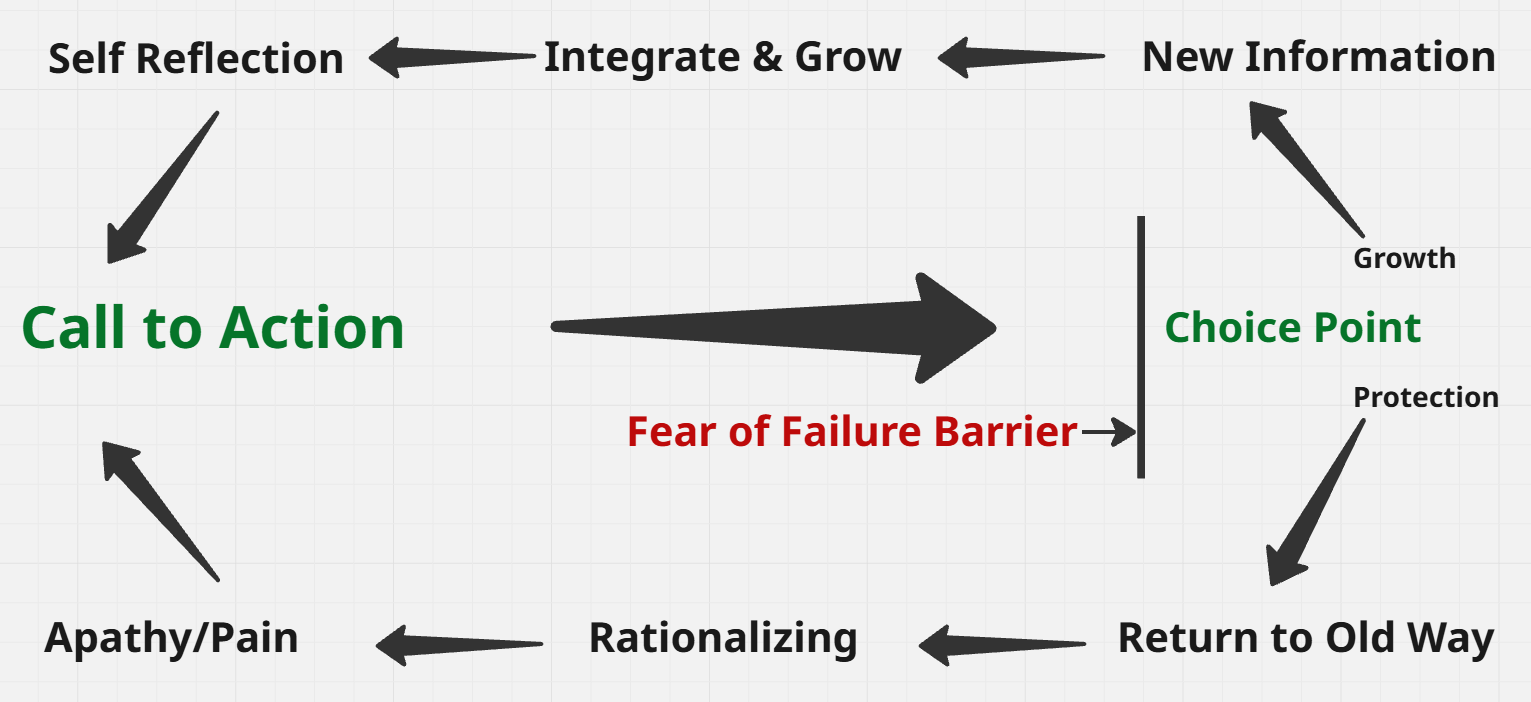
The Choice Loop Model is a visual continuum that illustrates how the choices we make can create a loop of either protection or growth.
It starts with a Call to Action. This is the point where something needs to change or an opportunity presents itself. All you have to do is go for it.
This could be the need for change due to pain and discomfort, or the desire for change due to opportunity and growth. It could be a whisper; it could be a scream.
Next, you take action (often without a real plan), and this is where the Choice Point presents itself. Here, things get difficult—a roadblock shows up. This could be external, internal, or practical.
External or internal like the naysayers mentioned before, or practical barriers like finances, location, time, etc.
This presents a choice: press forward into Growth or turn back into Protection.
Protection Path
Protection drives us to return to The old way and avoid potential failure.
This path leads to Rationalizing and making excuses:
“It wasn’t the right time.”
“I need to get my ducks in a row first.”
From there, we enter (or return to) a place of Apathy and malcontent. Thoughts like “There should be more to life than this” show up and eventually lead to another Call to Action.
Growth Path
Growth is hitting the same roadblocks but pressing forward anyway.
When leading with a growth mindset, one anticipates challenges. They typically create a thoughtful plan before taking action—this is where working with a coach often becomes invaluable.
They look for solutions with the understanding that regardless of the outcome, the result generates New Information that leads to learning, Intirgration and Growth…
If it didn’t work out:
Use the new information to adjust the next attempt.
If it did work out:
Celebrate the win.
Take inventory of the emotional response to the victory, so it can be cultivated during the next challenge.
Either way, this leads to Self-Reflection and eventually another Call to Action—completing the Growth Loop.
Broken Down Into Simple Steps
- Call to Action
- Choice Point: Protection or Growth
- Choose Protection → Return to the Old Way
- Rationalize
- Return to boredom, apathy, pain → back to Call to Action
3a. Choose Growth → New Information
4a. Integrate & Grow → Celebrate the victory
5a. Self-reflect → New Call to Action
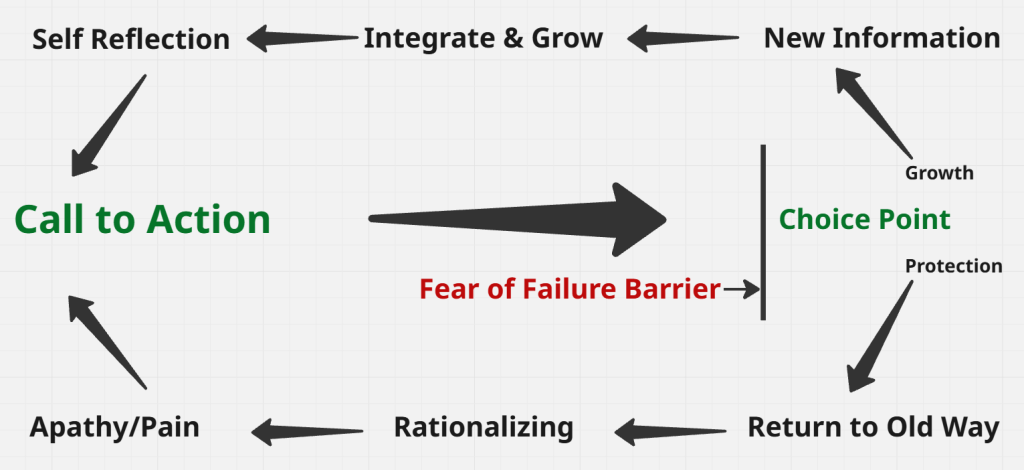
This model can help you identify for yourself if you’ve been caught in this kind of loop and decide how to make a change. One can get stuck in the loop several times before realizing it. In fact, it’s often the Call to Action that reminds us we’ve done it again.
The goal is to begin catching the choice as it arises.
This means strengthening your mindfulness and self-awareness skills.
There are often two sides to realizing you’ve been caught in the loop:
On one side: disappointment, even disgust, at noticing you’ve kept yourself stuck—realizing perhaps there has been a choice all along.
On the other side: awareness. The understanding that there is a choice, and it’s not too late—you can do something now.
Be kind to yourself for not knowing what you hadn’t yet learned.
Recognize that yes, it was a choice—but not one you were fully conscious of yet.
The journey is long and full of ups and downs. Through mistakes comes growth, so dare to mess it up and dare to fail forward.
And remember: you don’t have to do it alone.
Until next time,
Ciao!
Leave a Reply