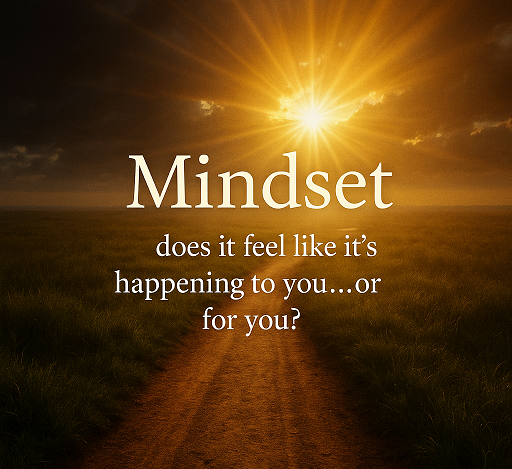
Life: Happening to You or for You?
I started my journey as a life coach and counsellor nearly seven years ago, and since then, I’ve worked with many people searching for why life feels so challenging.
The difficult story many of us adopt is that life is actively working against us. And to be clear, I include myself in this. Before my own journey, I found it very easy—comfortable, really—to say life is hard and then point a finger at others, the system, the government, or everyone’s favourite scapegoats: Mom and Dad. I blamed everyone for my circumstances—everyone except myself. Unless, of course, it was through self-deprecation, when I could confidently say I somehow deserved it.
It’s important to acknowledge that some things in life are truly out of our control. Tragic, heartbreaking things happen. But there are also many things that—although it might not seem like it in the moment—are within our control.
Before I go any further, I want to pause and acknowledge something: If you’re reading or listening to this and aren’t yet ready for change, this article might be a hard one to digest. Real change comes with personal accountability—a willingness to recognize where, although life can be difficult, much of what happens is influenced by our own choices. Even when we are victims of circumstance, we are still responsible for how we respond and what meaning we give to it. And that, my friends, can be a hard pill to swallow—until you discover the empowerment that comes with it.
What I want to talk about today is reclaiming control. Some things we can’t control, I understand that—but we can control what we make them mean. And there are other things we’ve let take over that we can reclaim.
I can remember my mom—who as I write this, sadly passed just two months ago—saying something when I was younger that has always stayed with me: “Ten percent of life is what’s dealt to you, and ninety percent is how you deal with it.” For that statement to hold true, an incredible amount of self-responsibility must also be true. It means that no matter what happens, we get to choose what to do with it.
So, the question becomes: Do you see life as happening to you or for you?
When we see life as happening to us, we place ourselves at the centre of a hostile universe—life is out to get us. But if life is happening around us, then we are participants in an ongoing experience. We’re impacted by what happens, yes—but we also get to choose the meaning we give to it.
Viktor Frankl once said: “The one thing you can’t take away from me is the way I choose to respond to what you do to me. The last of one’s freedoms is to choose one’s attitude in any given circumstance.”
Frankl, who survived multiple concentration camps including Auschwitz, understood life’s challenges in their deepest form. Today, many of us feel lost—unsure of what life is supposed to be about. For some, it just seems unfair. Life keeps throwing curveballs—sometimes big, sometimes small but relentless. We find ourselves asking, Why me?
This internal dialogue—If it weren’t for bad luck, I’d have no luck—is a sign of the victim mindset, or what psychology calls learned helplessness. It’s a place of giving up, pointing fingers, and surrendering control.
But there’s another way.
It begins with acknowledging that yes—the situation may truly be terrible. It’s not about pretending everything’s fine. It’s about accepting the suffering and then deciding, What’s next?
Even in the worst situations—like those Frankl faced—we can choose what to make them mean. We can give our suffering value by seeing how it contributes to our growth and deepens our understanding of life.
“Everything can be taken from a man but one thing: the last of the human freedoms—to choose one’s attitude in any given set of circumstances, to choose one’s own way.” —Viktor E. Frankl, Man’s Search for Meaning
Frankl once offered a metaphor that I often reflect on. Imagine an old-style tear-away calendar. Many people focus on how few days remain, anxious about running out of time. Others stare at the pile of torn pages—resentful, regretful, and overidentified with the past.
But what if, instead of discarding each torn page, you wrote something on the back—something you learned or survived that day? Even if it was a bad day, note how you endured it, what it taught you. Over time, those scattered pages would form a book of resilience instead of a pile of regret. You’d be able to look back, even on the hardest days, and see not just pain—but progress, growth, and meaning.
Believe me when I say—it’s easier said than done. It can be nearly impossible to look at tragedy and see anything but pain. I know because I’ve lived it.
I’ve lost several significant people, including my son and his mother. The toll was immense. It nearly broke me. I went through periods of self-medicating, suicidal thoughts, and depression that still visits from time to time. When I finally reached for help, I often found myself alone—met with detached professionals or family members who didn’t know what to do. The suffering was deep.
And yet, here I am—writing this to you.
“When we are no longer able to change a situation, we are challenged to change ourselves.” —Viktor E. Frankl, Man’s Search for Meaning
In time, I found meaning in my suffering. I became someone who could help others find what I couldn’t. I write this in hopes that one person might find what they need in these words. If that happens, then the loss of my son, his mother, and all those I’ve loved will have meant something. It still hurts—but it’s a hurt that has purpose.
In previous articles, I’ve talked about how purpose and direction make life more navigable, and how aligning with your values can clarify your path. Without those anchors, it’s easy to slip into maladaptive patterns—blaming, finger-pointing, or believing life is happening to you. But when you rediscover your “why”—what I call your Desired Life Outcome—you begin shifting from have to to get to. You start living with intention rather than reaction. You begin to see that life isn’t punishing you—it’s partnering with you.
“Those who have a ‘why’ to live can bear almost any ‘how.’” —Viktor E. Frankl
The journey will be messy. It will hurt. But you are not alone. Dare to mess it up. Dare to fail forward. And remember: life isn’t happening to you—it’s happening for you. Unitl next time ciao!!
— Christopher Testa, PCC
Ready for Change Coaching
Leave a Reply